Glass rarely breaks because someone dropped the box. It breaks because it was allowed to move — a plate rubbing against a plate for two hours until the edge goes, a vase shifting a centimetre with every corner the van takes until the centimetre becomes a fall. The whole craft of packing fragile things is removing the space they can travel in, not wrapping them more thickly. A heavily padded item with room to slide inside its box will still take damage; a lightly wrapped one with genuinely no room to move usually won't.
Why breakages actually happen
It's worth being specific about the mechanism, because it changes what's worth spending time on. Vibration and repeated small impacts over a long journey do far more damage, in aggregate, than the single dramatic drop most people picture when they imagine something breaking in a move. A box that rattles even slightly at the start of a journey has usually rattled itself into a very different, much worse state by the end of it. That's why the goal of packing fragile items isn't padding for its own sake — it's eliminating movement entirely, so nothing inside the box has anywhere to go regardless of how many hours it spends in transit.
Plates on their edge, never stacked flat
A stack of flat plates concentrates the whole weight of the stack on the bottom one and gives every plate a flat face to slap against its neighbour. Wrap each plate individually and stand them on their edges, like records in a rack, inside a box with dividers or thick padding between each one. Plates and other flat china are far stronger through the edge than through the face — a structural fact about how ceramics fracture, not just a packing convention — which is why edge-packing survives a move that flat-stacking often doesn't.
Glasses get filled
Stemware and tumblers are packed upright with the inside stuffed — packing paper, a sock, anything soft — so the walls cannot flex under pressure. Then wrapped on the outside, then stood in a box with dividers or with enough padding between each glass that none of them touch each other or the sides of the box. Stemmed glasses in particular fail at the thinnest point, the stem itself, which is exactly the part most likely to be left unsupported if only the bowl of the glass is wrapped.
Mirrors, framed art and anything flat and glazed
Flat glazed items — mirrors, picture frames, framed certificates — fail differently to crockery: the risk is a flex or a direct knock to the flat face, not vibration inside a box. These are best moved edge-on rather than flat, in a box built for the purpose or between two flat, rigid pieces of cardboard cut to size and taped together as an improvised sandwich if a proper picture box isn't available. Never lay several framed pieces flat on top of one another in a single stack; the weight of the top ones flexes the glass in the ones underneath, and glass fails under exactly that kind of flex.
Lamps and anything with an awkward, delicate shape
Lampshades in particular are more fragile than they look and resist standard box-and-wrap packing because of their shape — a fabric or paper shade can crush or dent even when nothing has actually struck it, simply from being packed against something less forgiving than itself. Pack a shade on its own, in a box sized close to its own dimensions rather than a large one it can shift around inside, and use the base of the lamp as a separate, sturdier item wrapped and packed with other solid objects rather than with its own shade.
Electronics and screens
Televisions, monitors and anything with a large flat screen travel best upright, in their original packaging if it's still available, since manufacturer packaging is specifically engineered for exactly this kind of transit stress. Where original boxes aren't available, a dedicated flat-screen box with the corner supports it comes with is the next best option; wrapping alone, with nothing rigid protecting the corners specifically, leaves the single most vulnerable part of the item unprotected. Screens should never travel flat, since even moderate weight on top of a screen laid horizontally can crack it in a way that upright transit doesn't risk.
China sets, ornaments and anything irreplaceable
Anything from a set — a dinner service, a collection of the same type of ornament — is worth treating individually rather than as a group, since packing one badly in a set of twelve is still one broken item, and the temptation to speed up as you work your way through a large collection is exactly when standards slip. For anything genuinely irreplaceable, whether by sentimental value or cost, it's worth packing it noticeably more carefully than the rest of the fragile items, and telling whoever is loading the van which box it's in, so it gets handled with that in mind rather than treated as one box among many identical-looking ones.
The shake test
Close the box and shake it gently. If you hear anything move, it is not finished. Fill the gap and shake it again. A properly packed fragile box is silent and feels solid rather than rattly — that silence is the actual test of whether the packing has worked, not how much bubble wrap went into the box or how long it took to pack.
Weight belongs in small boxes
Books and crockery go in small boxes; duvets and cushions go in big ones. A large box filled with heavy things will fail at the base, usually while someone is carrying it down stairs, which is both a breakage risk to whatever's inside and a real injury risk to whoever's carrying it. If a box can't be lifted comfortably, nobody else can lift it comfortably either, regardless of how strong they look.
Materials worth having, and what each one actually does
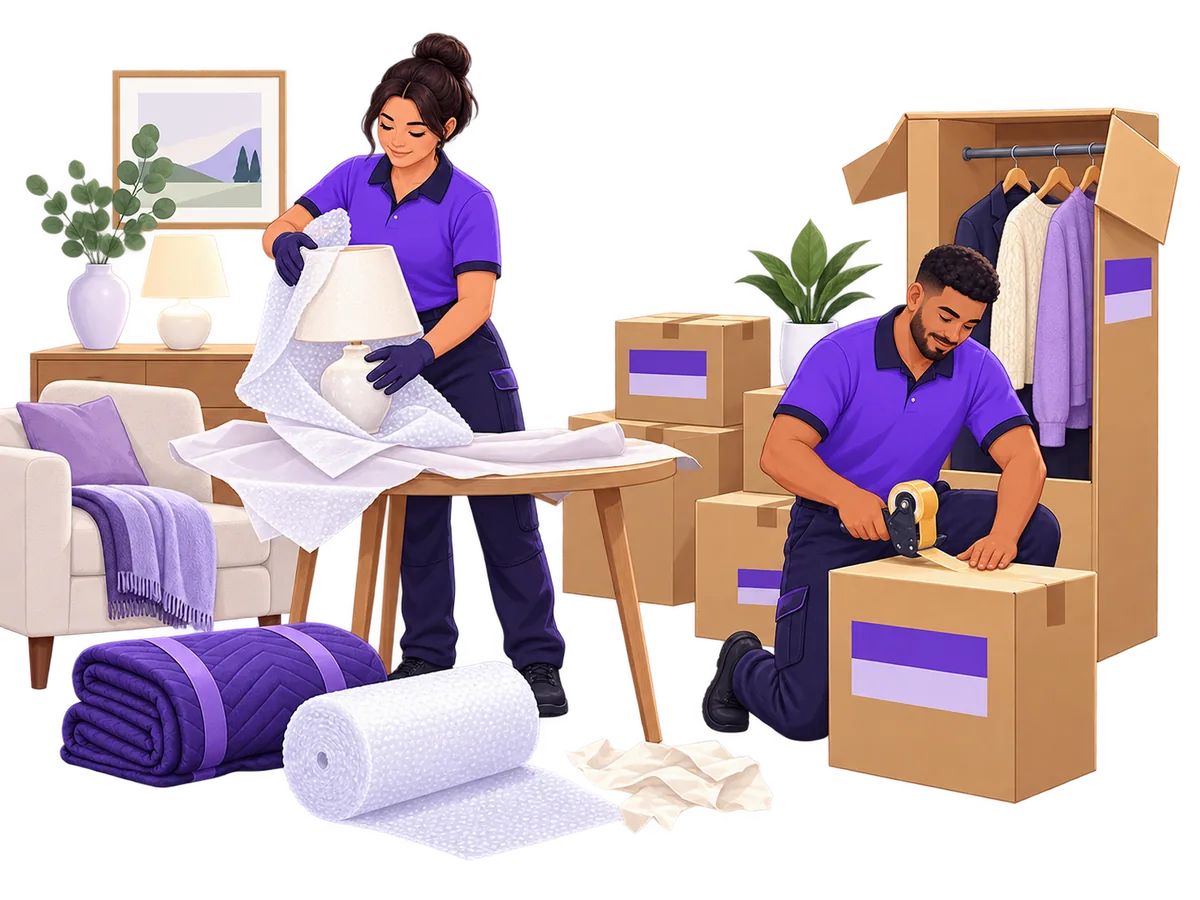
Bubble wrap protects against impact and is best used on corners and points of contact rather than wrapped uniformly, since a uniformly wrapped item can still shift inside a loosely packed box. Packing paper (plain, not printed newsprint) is for filling void space and preventing ink transfer onto anything pale or porous — printed newspaper is cheap and widely available but will genuinely transfer ink onto light-coloured ceramics and fabric left in contact with it for any length of time. Furniture blankets protect large surfaces from scuffing rather than from impact, and are the right choice for wrapping furniture edges and glass tabletops rather than small breakable items. Using the wrong material for the job — bubble wrap as void-fill, or paper as impact protection on a genuinely fragile corner — is a common reason a well-intentioned packing job still results in damage.
Double-boxing for the things that matter most
For anything unusually valuable or fragile, packing it into a well-padded inner box and then placing that box, with further padding on all sides, inside a second, larger outer box gives it a genuine buffer against impacts from outside that a single box can't provide. This takes more time and more material than standard packing, which is exactly why it's worth reserving for the handful of items in a house that would actually be missed if they didn't survive the move, rather than applied to everything.
Label the side, not the top
Boxes get stacked. A label on the top of a box is invisible the moment another box goes on top of it. Write the room and the word FRAGILE on at least two sides, ideally two adjacent sides rather than opposite ones, so it's visible from more than one angle regardless of how the box ends up oriented in the van.
Insurance and what it actually covers on fragile items
Goods in Transit cover applies to fragile items the same way it applies to everything else being moved, but it's worth understanding in advance what a claim on a broken item actually needs: evidence of the item's condition beforehand if possible, and a description of how it was packed, since cover typically distinguishes between damage that occurred despite reasonable packing and damage to something that was packed in a way unlikely to survive any move. This is one more reason the packing itself matters, beyond simply avoiding the breakage in the first place.
Wine, spirits and glass bottles
A wine collection or a drinks cabinet is a category of fragile item that's easy to underestimate, since bottles feel sturdy individually but are heavy in aggregate and vulnerable to breaking at the neck if they knock against each other repeatedly. A dedicated bottle box with internal dividers is the safest option where a genuine collection is involved; failing that, wrapping each bottle individually and packing upright in a small, sturdy box — never laid on their sides loose in a large box — prevents both breakage and the considerably worse outcome of a leaking bottle ruining everything else in the box around it.
Musical instruments
A guitar, violin or similar instrument in its own hard case is one of the easier fragile items to move well, since the case is already engineered to protect it — the main risk is the case itself being stacked under something heavy or stood on an edge it wasn't designed to bear weight on. A piano is a different category of problem entirely: it needs specialist handling, appropriate equipment and, ideally, people who move pianos regularly rather than as an occasional part of a general house move, because its weight distribution and value make it one of the few items where general removals experience isn't necessarily the same as piano-specific experience.
Garden and outdoor fragile items
Garden ornaments, pots and anything ceramic kept outdoors are easy to overlook when planning for "fragile items," since the instinct is to think of glassware and china indoors, but terracotta and ceramic pots crack through exactly the same vibration mechanism as anything else fragile, and are often packed last-minute with far less care than indoor breakables. Wrapping and boxing garden ceramics the same way as anything else fragile, rather than assuming their outdoor durability against weather also means durability against a moving van, avoids a genuinely common and avoidable loss.
Professional packing versus doing it yourself
There's no single right answer to whether fragile items should be packed personally or handed to a crew, and the honest trade-off is between two different kinds of risk. Packing personally means knowing exactly how each item was wrapped and exactly where it is, which matters for anything with strong sentimental value regardless of its actual fragility. Professional packing means the people doing it pack fragile items for a living and have likely packed thousands of the exact category of thing being handled, with materials and techniques refined by doing it constantly rather than once every few years. For most households, a sensible middle ground is packing the everyday and sentimental items personally, and handing over the genuinely fragile and valuable ones — glassware, art, electronics — to be packed by people doing it as their actual job.
Boxes matter as much as the wrapping
Even perfect wrapping can't compensate for a box that's the wrong shape or condition for the job. A box that's slightly too large for a small number of heavy, fragile items leaves room for exactly the kind of movement that causes breakage, however well each individual item was wrapped going in. A box that's been used several times already and has softened at the corners no longer provides the structural protection a fresh one does, particularly if other boxes end up stacked on top of it. Fragile items deserve boxes in good condition, sized closely to what's actually going inside them, more than they deserve extra layers of wrapping compensating for a box that's the wrong fit.
Sealing and reinforcing a fragile box properly
The base of a box carries the full weight of everything inside it, and a base sealed with a single strip of tape is the single most common point of failure in an otherwise carefully packed fragile box. Reinforcing the base with tape in both directions — along the centre seam and across it — before anything goes inside is a small step that prevents a genuinely common failure: a box giving way at the bottom while being carried, regardless of how well its contents were wrapped.
Vases, bowls and irregularly shaped ceramics
Anything without flat, predictable sides — a vase, a bowl, a sculptural ornament — is harder to pack well precisely because it doesn't sit neatly against the walls of a standard box the way a plate or a book does. The right approach is to wrap the item fully, then build a nest of crumpled paper inside the box first, sit the item into that nest, and fill in every remaining gap around it before closing the lid, so the irregular shape is fully supported from every direction rather than resting against one wall with a gap on the other side. Taller items are more stable stood upright inside a snugly sized box than laid on their side, where a curved surface can roll even inside padding.
Clocks, ornaments with moving parts, and anything mechanical
Clocks, music boxes and anything else with an internal mechanism benefit from a small amount of extra thought beyond standard wrapping: securing or removing any part that can swing or move freely — a pendulum, a hinged door, a loose internal component — before wrapping the item as a whole. A mechanism free to move inside a wrapped, boxed item can do more damage to itself over a long journey than an external impact would, simply by swinging repeatedly against its own housing for the length of the trip.
How much padding is actually enough
There's a natural instinct to equate more bubble wrap with more safety, but past a certain point extra wrapping just adds bulk without adding meaningfully more protection, while making it harder to tell by touch or by the shake test whether an item is actually secure inside its box. The right amount of padding is however much stops the item moving at all — verified by the shake test, not by how much material was used — and no more than that is actually necessary.
A packing order that avoids re-doing work
Fragile items are easiest to pack well when they're one of the last categories boxed, not one of the first — by that point in a move, the room is emptier, there's more space to work carefully, and there's a clearer sense of exactly how much padding material remains for the items that need it most. Packing the fragile boxes first, when a room is still full of other things to work around, tends to produce faster but less careful results than packing them last, when there's finally room to do it properly.
Children's fragile and sentimental items
Items belonging to children — a favourite ornament, a trophy, a piece of art they made — are worth the same care as anything else fragile, and often benefit from being packed with the child involved if they're old enough, both to make sure nothing important to them is missed and to give them some ownership over a day that otherwise happens entirely around them. A small, clearly labelled box of a child's own fragile things, kept accessible rather than buried in the main load, is a small piece of planning that makes the first evening in a new home noticeably easier for them.
A final check before the van is loaded
Before fragile boxes are carried out to the van, it's worth a last check that each one is genuinely sealed on all sides, clearly labelled on at least two faces, and — if the shake test hasn't been done recently — given one more shake to confirm nothing has settled or shifted since it was packed. This final pass takes only a few minutes across a whole house's worth of fragile boxes and catches the small number that inevitably need a last adjustment before they're loaded alongside everything else and become much harder to access.
Or hand it over
Packing materials are included on our jobs — bubble wrap, shrink wrap, wardrobe cartons and furniture blankets — and fragile-only packing exists precisely so the glass and the artwork can be handed over to be packed properly, while the books and the everyday things stay something you handle yourself if that's the split that makes sense for a particular move.